

A Poignant Field Trip: Political History of Chile
- chloedemarce
- May 31, 2023
- 4 min read
One of the last group excursions I embarked on before the end of the semester was a program field trip to the Palacio de la Moneda (basically the White House of Chile) en el Centro de la ciudad. Our professors had lined up a tour of the Palacio so we could see and learn a bit more about the presidency and history of politics in Chile.
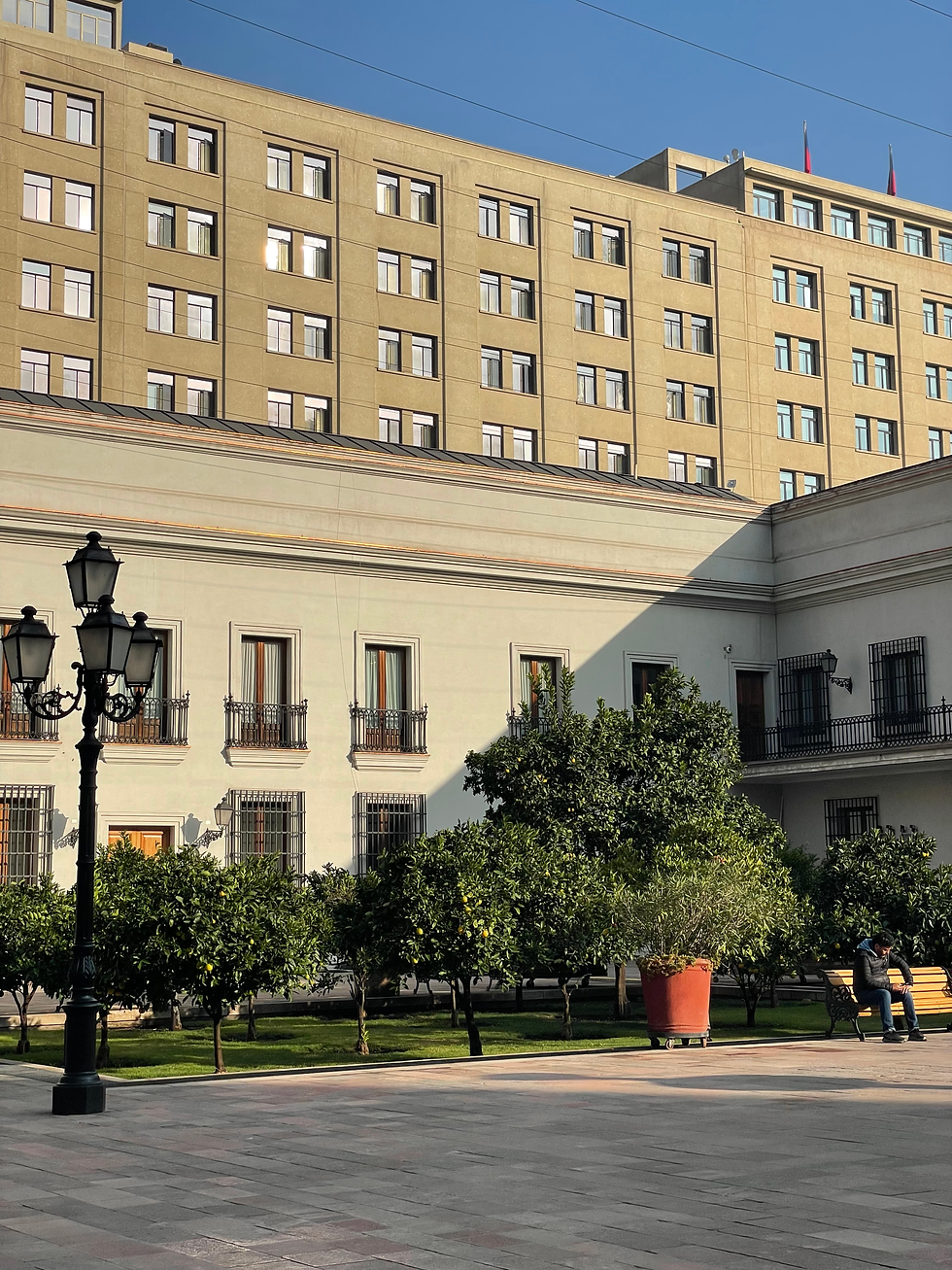
The first thing I noticed was the pristine architecture of the building. This entire area was a massive, colonial style bu
ilding with architecture that reflected the long, arduos history of European settlement back in the 15th century. We learned that the Chile's current U.S. president, Gabriel Boric, rides his bike every day to the Palacio to clock into his full-time role of leading a predominately conservative country a little further to the left. We also got to see the door where political and military officials looked out back in 1973 when the Palacio was

being bombed by Pinochet's military forces in the Golpe Militar del Estado. As we climbed up the stairs, we see a massive gold-plated coin with the regal face of Chile's 28th president Salvador Allende, who led the socialist party up until the fateful day on September 11th, 1973.
It was interesting because our professors had shared with us that the original story is that in Allende's final moments and after his final words had been broadcasted to the country via a radio, he took his own life by gunshot. However, after investigations had been carried out, the evidence confirmed that he had not in fact killed himself, he had been shot by a militant under Pinochet's regime. During our tour however, the lady that was leading and providing information about each room expressed that he had killed himself. I asked my professors afterwards if they had caught her saying that and they all rolled their eyes and held up their two fingers in quotations "killed himself". However this is what a large amount of the Chileans and the world believe despite the evidence.
After our tour, we then headed next door and below to the Centro Cultural de la Palacio de La Moneda where we walked through a beautiful art exhibit dedicated to artistas jóvenes (young artists) who had created radical works that all spoke to Chilean society whether that be past, present, or future. There were exhibits demonstrating ecological destruction of the precious geographical diversity, critiques on the patriarchy induced even further during the dictatorship, and expansive ideas relating to gender and sexual identity, amongst others.
Our last stop of the day was to arguably one of the most important historical/cultural centers in Chile, El Museo de Los Derechos Humanos. I had not yet had an opportunity to visit there yet and I knew it was essential to my overall understanding and comprehension of the reality of the dictatorship back then, as well as now. Inside, we saw several works of art that all related to the years during the dictatorship. Hanging on the massive concrete

walls were thousands of black and white images of the several men and women that went missing, were tortured, kidnapped, or murdered over the 17 years of Pinochet. We saw videos of the golpe militar and the bombing of the Palacio de La Moneda we had just seen early that morning, except fully recovered and reconstructed from the bomb damage.
One of the more powerful exhibits showed small glass casings of seemingly ordinary objects such as pencils, little scraps of paper, a small trinket, and a metal piece of tile covering adorned with a seahorse. The testimonies of tortured victims shared that these seahorses, found on the floors of the rooms where innocents were put through intense torturing methods, provided something to focus on and concentrate on during the pain and the suffering. Small artifacts like these have the power to shed even the smallest light onto the violence, oppression, and injustice that innocent Chileans and others alike suffered for many years.
For myself, as a young, cisgender, white, North American, I felt the weight, darkness, pain, and anguish through these momentos and exhibits from the past. For a chilean, or indigenous person, or fellow Latin American, I cannot imagine how these feelings are amplified and run even deeper, to the core of their very being. Empathy has varying levels and I can not quite imagine what it must be like to have lived through or even after such a time that truly was not that long ago. More of what I learned solidified what my professors had tried to get us to understand: That the effects of the dictatorship still run rampant and are embedded into Chile's social fabric and continue to manifest into the present moment because their has been little to no justice served to right the wrongs of the atrocity of Pinochet's regime. Until the collective memory is resurrected, validated, prosecuted, and rectified, will there be any chance at progressing forward towards a better, brighter, just, and safe future for Chile. ¿Cómo podemos recuperar la memoria para superar y avanzar el presente, y el futuro abierto?


Comments